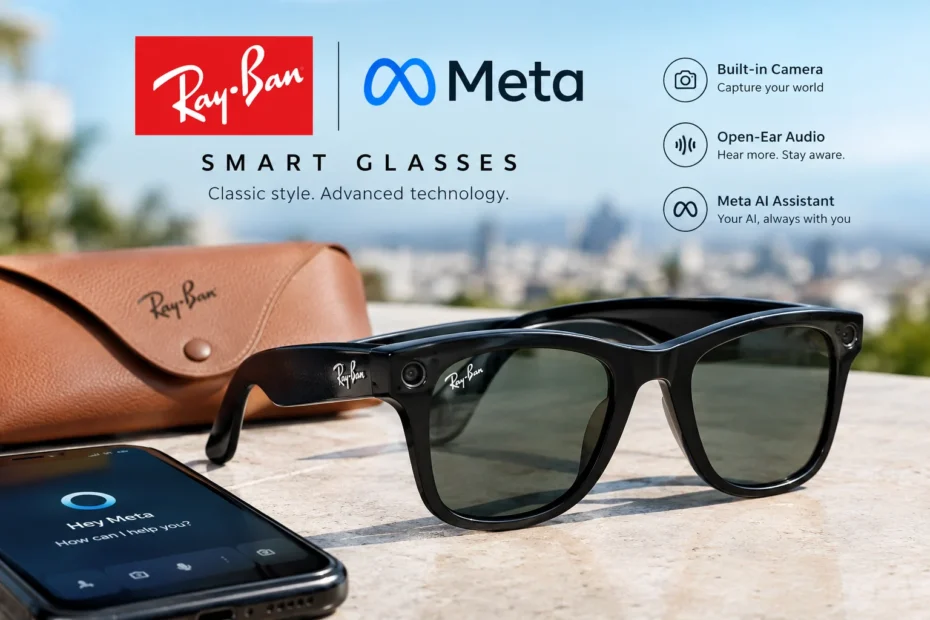
You do not need a headset to put a camera, speakers, and an assistant on your face. That is the whole pitch behind rayban meta glasses. They look like Wayfarers or Aviators. They also record video, play open-ear audio, and answer “Hey Meta.”
I have watched this category since the old Ray-Ban Stories flopped in 2021. Those were a camera toy. The 2023 rayban meta glasses were the first pair people actually wore past the first weekend. By early 2026, the partnership between Meta and EssilorLuxottica had turned smart eyewear into a real product line, not a demo.
Here is the catch. The name covers more than one product. Camera glasses, a display pair, and a newer audio-only pair all sit under the same brand. Buy the wrong one, and you pay extra for a screen you will not use, or you skip the screen and then wish you had maps in the lens.
Quick Answer: Rayban Meta glasses are wearable tech glasses from Meta and Ray-Ban. The main line is camera, open-ear audio, and Meta AI, with no screen in the lens.
Gen 2 starts around $379 in the US and claims up to 8 hours. Meta Ray-Ban Display starts at $799 and adds a small full-color screen plus a wristband. Gen 3, announced at Connect 2026, starts at $449 and claims up to 9 hours. None of these are full augmented reality headsets.
What are rayban meta glasses, really?
Direct Answer: Rayban Meta glasses are classic Ray-Ban frames with a camera, microphones, open-ear speakers, and Meta AI, built with EssilorLuxottica.
Look, the frame is the product. Meta did not invent a new face shape and hope you would tolerate it. Ray-Ban already owned Wayfarer. EssilorLuxottica already owned the stores, the lens labs, and the prescription desks. Meta brought the chip, the assistant, and the app.
The first rayban meta smart glasses landed in fall 2023 at about $299 in the United States. A 12-megapixel ultra-wide camera sat in the front. Speakers sat in the temples. A small LED was meant to show when the camera was on. You talked to Meta AI, took a photo, or started a clip without pulling out a phone.
EssilorLuxottica said in February 2025 that Ray-Ban Meta had passed 2 million units since launch. In February 2026, the same company said it sold more than 7 million AI glasses in 2025 across Ray-Ban and Oakley. Counterpoint and Omdia later put Meta’s share of this market well above 80 percent. Those are portfolio numbers, not a single SKU, but they explain why every other brand is chasing this shape.
Key Takeaway:
- The glasses are a Ray-Ban frame first and a gadget second.
- The 2023 line proved people would wear a camera on their face if it looked normal.
- Sales figures cover Ray-Ban and Oakley Meta glasses, not one model only.
Meta and Ray-Ban eyewear
Five Ray-Ban Meta lines and what each pair includes
These glasses come from Meta’s partnership with EssilorLuxottica, the owner of Ray-Ban and Oakley. The Ray-Ban pairs use familiar frames such as Wayfarer and Aviator, then add a camera, open-ear speakers, and the Meta AI assistant. One line adds a lens screen. Oakley is the sport branch of the same partnership, not a separate camera system.
| Line | Maker | US start price | Camera and video | Audio and assistant | Battery claim | Lens screen | Frames |
|---|---|---|---|---|---|---|---|
| Ray-Ban Meta (Gen 1) | Meta with Ray-Ban | About $299 at the 2023 launch | 12 MP ultra-wide camera; 1080p-class video | Open-ear speakers, mic array, Meta AI, “Hey Meta” | About 4 hours typical use; case up to about 32 extra hours | None | Wayfarer, Headliner, Skyler |
| Ray-Ban Meta (Gen 2) | Meta with Ray-Ban | $379; Optics frames often from $499 | 12 MP; 3K Ultra HD video, 1080p up to 60 fps on some modes; 32 GB storage | Open-ear speakers, five-mic array, Meta AI | Up to 8 hours mixed use; about 5 hours continuous audio; case up to 48 extra hours | None | Wayfarer, Headliner, Skyler; later Blayzer Optics and Scriber Optics |
| Ray-Ban Meta (Gen 3) | Meta with Ray-Ban | $449; on sale from 23 September 2026 | 12 MP front camera; up to 3K video at 30 fps | Open-ear speakers, microphones, Meta AI; slimmer wear than Gen 2 | Up to 9 hours mixed use | None | Aviator, Wayfarer, and Zena, in many color sets |
| Meta Ray-Ban Display | Meta with Ray-Ban | $799, Neural Band included; £749 UK; CA$1,149 Canada; from €899 in France, Italy, and Germany | 12 MP with 3x zoom; video around 1440×1920 at 30 fps | Open-ear speakers, mic array, Meta AI, wrist control via Neural Band | Up to about 6 hours mixed use | Full-color monocular screen, 600×600, about 20° field of view, in the right lens | Wayfarer-style; Transitions lenses; narrower prescription range than standard Ray-Ban Meta |
| Oakley Meta | Meta with Oakley | HSTN often near the Ray-Ban camera-glasses band; Vanguard priced higher for sport use | 12 MP class camera on HSTN; sport-tuned capture on Vanguard | Open-ear speakers and Meta AI, built for outdoors rather than office wear | Varies by model; check the current Oakley Meta page | None on HSTN and Vanguard | Sport shields and performance frames, not Wayfarer or Aviator |
Gen 1, Gen 2, and Gen 3 keep the lenses clear of pixels. Captured photos and video are reviewed in the Meta app. Meta Ray-Ban Display is the only pair in this set that can show directions, captions, and message previews in the lens. A capture light is meant to show when the camera is recording. Water resistance on the Ray-Ban camera pairs is splash-level (IPX4), not a swim rating.
How do Ray-Ban Meta Gen 1, Ray Ban Meta Gen 2, and Ray Ban Meta Gen 3 differ?
Direct Answer: Gen 1 was the 2023 camera-and-audio pair. Gen 2, from September 2025, doubled claimed battery life and raised video to 3K. Gen 3, from September 2026, is a slimmer camera pair that starts at $449 and claims up to 9 hours.
Rayban meta gen 1 is the pair a lot of owners still wear. Launch price was about $299. Meta claimed roughly 4 hours of typical use and about 32 extra hours in the case. Video sat in the 1080p class. Frames were Wayfarer, Headliner, and Skyler—no lens screen. Suppose a listing says “Ray-Ban Meta 2” without a year; ask which generation. Sellers mix the names.
Rayban meta gen 2 was announced at Meta Connect on September 17, 2025. US starting price is $379. Meta claims up to 8 hours of typical use, about 5 hours of continuous audio, and up to 48 extra hours from the case. A 20-minute charge can reach about 50 percent.
Video is marketed as 3K Ultra HD, with 1080p up to 60 frames per second on some modes. Storage is 32 GB. The chip is still Qualcomm’s Snapdragon AR1 Gen 1. Water resistance is IPX4, which means splashes, not a pool.
New Ray-Ban Meta in late 2026 is mostly Ray-Ban Meta Gen 3. Meta put that pair on sale around September 23, 2026, at $449 in the US. The pitch is comfort, audio, and battery, not a new camera class. Claimed mixed-use life is up to 9 hours.
Styles include Aviator, Wayfarer, and a newer Zena shape, with a wide set of color combinations. A separate Ray-Ban Meta Audio pair, with no camera, was priced at $349 and set to ship in mid-October 2026.
Spec Gen 1 Gen 2 Gen 3
US start price about $299 $379 $449
Claimed mixed battery about 4 hours up to 8 hours up to 9 hours
Video headline 1080p class 3K Ultra HD 3K at 30 fps
In-lens display No No No
Best for Used deals Daily camera and calls Newer fit and battery
I learned this the hard way on a used listing. The seller wrote “new rayban meta” and shipped Gen 1. The case hours and the video setting gave it away in two minutes.
Key Takeaway:
- Gen 2 fixed the two complaints that defined Gen 1: battery and video.
- Gen 3 is an incremental wear upgrade, not a screen upgrade.
- Always match the model year before you compare prices.
What is Ray Ban Meta Display, and who actually needs it?
Direct Answer: Meta Ray-Ban Display is a separate pair with a full-color screen in the right lens and a Neural Band wrist controller. It starts at $799 in the US.
This is the mix-up that wastes money. Ray Ban Meta Display is not “Gen 2 with a screen.” Meta announced it alongside Gen 2 in September 2025. The screen is about 600 by 600 pixels, with a 20-degree field of view, high peak brightness, and a monocular layout. You see directions, captions, message previews, and photo checks. People next to you mostly do not.
The bundle includes the Meta Neural Band. It reads muscle signals at the wrist so you can pinch and swipe without poking the frame. Claimed battery life is about 6 hours of mixed use, shorter than Gen 2. Weight is higher, around 69 grams versus about 52 grams on Gen 2 Wayfarer-style pairs. Prescription range on the display pair is narrower than on some standard Ray-Ban Meta optics.
At Connect 2026, Meta opened online ordering in the US and expanded sales. Published prices were £749 in the UK, CA$1,149 in Canada, and from €899 in France, Italy, and Germany, with those European shops opening mid-October 2026. New software included cycling and transit directions, landmark walking cues, and more phone notifications in the lens. Feature timing still depends on country.
Andrew Bosworth’s team and Mark Zuckerberg have treated this pair as the bridge to visual AI, not as the default buy. The Verge’s early hands-on called the screen the best smart-glasses display the writer had tried. That does not make it the right $799 for someone who only wants music.
Key Takeaway:
- Pay the display premium only if you want text in the lens.
- The Neural Band is part of the product, not an optional toy.
- Gen 2 and Gen 3 stay camera-and-audio glasses on purpose.
Which rayban meta wayfarer, men’s, and women’s fits are worth it?
Direct Answer: Wayfarer is the default unisex shape. Skyler leans cat-eye. Headliner is rounder. Optics frames exist for people who need a built-in prescription look.
Ray Ban Meta Wayfarer is the pair you see in ads because the shape hides the electronics. Temples are thicker than plain Wayfarers, on a narrow face that bulk shows. On a wider face, it disappears.
Men’s rayban meta glasses are usually Wayfarer or Headliner in larger sizes. Women’s rayban meta glasses often mean Skyler, the cat-eye or butterfly shape, or a smaller Wayfarer. Meta does not lock frames by gender. Fit does. A Skyler on a broad face can sit high—a large Wayfarer on a small face slides.
Spring 2026 brought prescription-focused frames such as Blayzer Optics and Scriber Optics, often starting near $499 in the US before lens upgrades. Standard Gen 2 still takes single-vision and progressive lenses through Ray-Ban and partner shops, with a wide power range in the US. Display prescriptions are more limited.
Try this before you buy:
- Measure your current frame’s lens width and bridge.
- Pick two shapes, not one color.
- Wear them 10 minutes with your phone in a pocket. Open-ear sound leaks. You need to hear that leak in a quiet room and on a street.
- If you need a prescription, book the optical visit first. Online clear-lens prices are not your final price.
Image to add: a side-by-side of Wayfarer, Skyler, and Headliner on three face shapes, with temple thickness called out.
Key Takeaway:
- Shape beats color. A bad bridge fit ruins the camera angle.
- Prescription pairs cost more and take longer.
- “Men’s” and “women’s” are marketing labels, not separate computers.
What can you actually do with rayban meta smart glasses?
Direct Answer: You can shoot photos and short videos, take calls, play audio, ask Meta AI about what the camera sees, and hear live translation. You cannot get a full AR map unless you buy the Display pair.
The camera is a 12-megapixel ultra-wide. Default stills land around 3024 by 4032. Gen 2 and Gen 3 push video toward 3K. Clips are short. Three minutes is a common cap. Framing is the weak spot. You cannot see the shot on Gen 1, Gen 2, or Gen 3. You point, shoot, and check the phone. Display owners can preview in the lens.
Open-ear speakers are clear for podcasts and calls. Bass is thin. A subway car will hear your chorus. Conversation Focus and a multi-mic array help calls. Wind still wins sometimes.
Meta AI is the reason these are artificial intelligence glasses, not just Bluetooth speakers. You can ask it to identify a building, draft a caption, or translate speech. Live translation has covered a small set of languages, not every language you travel with. Visual answers go through the cloud. That means delay, data use, and a privacy choice.
A friend in Austin used a Gen 2 pair to narrate a Saturday market without stopping to type. The captions were useful. The AI also misread a spice label. Treat visual answers like a sharp intern, not a lab result.
Privacy is the part reviewers keep missing. The capture LED is there so other people know the camera is live. It is not a legal shield. Filming in a gym, a school, or a private office can still get you thrown out. In the EU and the UK, bystander rules are stricter than in much of the US.
Key Takeaway:
- Best daily jobs are hands-free photos, calls, and quick questions.
- AI can be wrong. Check anything that matters.
- The LED does not replace consent.
Rayban Meta glasses vs. other AI wearable devices
Direct Answer: Rayban Meta glasses lead sales because they look like normal eyewear. Oakley Meta is the sport cousin. True augmented reality glasses with wide overlays are still heavier and rarer.
Oakley Meta HSTN and Oakley Meta Vanguard share the Meta stack and aim at outdoors. Vanguard is the pair for sweat and trails. Ray-Ban is the pair for a meeting and a dinner: same idea, different face.
Display-less rivals from Xiaomi and others show up in shipment charts at about 1 percent each in early 2026, per Counterpoint’s display-less cut. Apple has been rumored as the next large entrant. Until that pair ships, comparison shopping is mostly Meta versus Meta.
These are not next-generation glasses in the sci-fi sense. Futuristic glasses with a wide holographic desktop are a different device. Meta’s own higher-end VR glasses, priced around $1,300 and aimed at 2027, sit in that other bucket. Connected eyewear in this article means a phone-paired frame.
Image to add: a simple three-column chart labeled Camera glasses, Display glasses, and Headset, with price bands and “can you wear them to lunch?”
Key Takeaway:
- Buy Ray-Ban for daily wear, Oakley for sport.
- A 20-degree screen is not a holodeck.
- Market share is not the same as the best pair for your face.
Myths, a buyer checklist, and what I would skip
Direct Answer: The expensive pair is not automatically the better pair. Match the job, then the frame, then the price.
Myth: rayban meta glasses are augmented reality glasses. Only the Display model puts pixels in a lens, and even that view is small.
Myth: Gen 3 replaces Gen 2 for everyone. If you find a Gen 2 Wayfarer on sale and the fit is right, the camera class is close.
Myth: They replace your phone. They need the phone and the Meta app. Dead phone, weaker glasses.
Beginner vs expert:
- A beginner should start with Gen 2 or a discounted Gen 3 in a known frame size.
- An expert who already lives in captions and walking directions can justify Display.
- Nobody should buy Display only because the ad looks futuristic.
Quick checklist:
- Confirm generation, not just “Ray Ban Meta.”
- Confirm battery claim and case hours.
- Confirm prescription path and total price.
- Test open-ear leak.
- Read the return window. Fit regrets are common.
- Decide if you are willing to wear a camera LED in public.
Image to add: a photo of the charging case, the capture LED, and the Meta app gallery on a phone.
Key Takeaway:
- Most people should buy camera glasses, not the Display.
- Fit and return policy matter more than a spec bump.
- Skip any seller who will not name the generation.
Bottom line
Rayban Meta glasses won because they look like glasses. Gen 1 proved the idea. Gen 2 made the battery usable. Gen 3 trims the wear. Display is the first pair in this family that shows you words without a phone in your hand. EssilorLuxottica’s 2025 sales spike, past 7 million AI glasses with Oakley included, says the category is past the gadget-blog phase.
Bottom line: Buy Gen 2 or Gen 3 if you want a camera, calls, and Meta AI in a Wayfarer or Skyler. Buy Meta Ray-Ban Display only if you will use the lens for directions, captions, or message previews several times a week. Check the generation, the prescription total, and the return window before you pay.
If you already own a pair, say which frame and city you wear them in. Fit notes from real faces beat another spec sheet.
References:
- EssilorLuxottica full-year results discussions, February 2025 and February 2026, on Ray-Ban Meta unit milestones and 2025 AI-glasses sales.
- Meta Newsroom, “Making Meta Ray-Ban Display More Useful to More People,” September 23, 2026.
- The Verge, Meta Ray-Ban Display hands-on, September 18, 2025.
- Counterpoint Research and Omdia shipment commentary, reported in June and September 2026, on AI-glasses share.
- Meta Connect 2025 and 2026 product briefings for Gen 2, Display, Gen 3, and Ray-Ban Meta Audio pricing.
Read More: Snap Planets