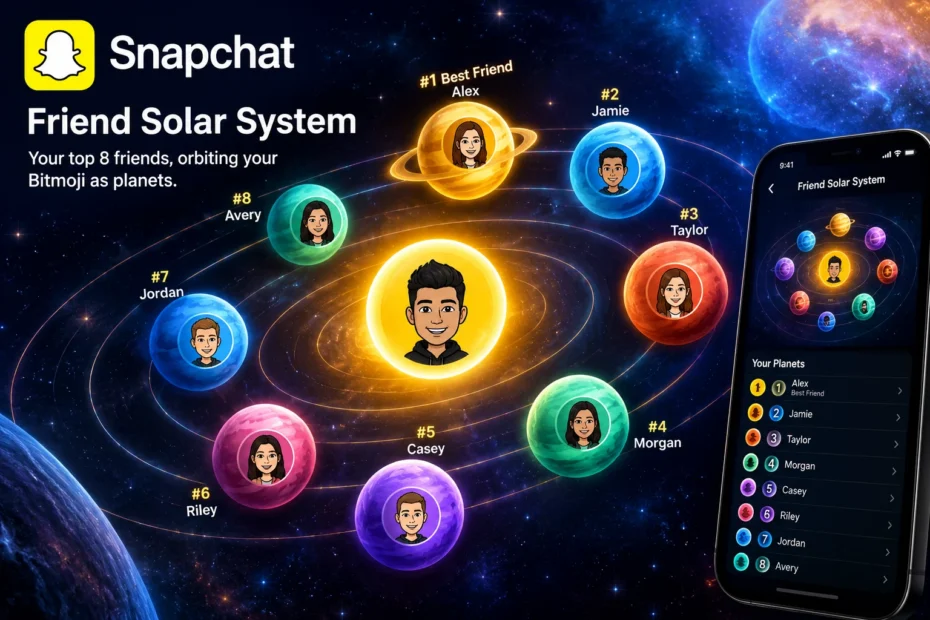
Introduction
You open a friend’s profile. There it is: a tiny planet floating next to their Bitmoji. Are you their Mercury? Their Neptune? Or worse — are you not even in their orbit?
Here’s the thing about snap planets: they’re equal parts fun and brutal. One day you’re someone’s #1. The next, you’ve slid to Jupiter because you forgot to reply to three snaps.
I’ve been testing this feature since it dropped. I’ve watched friends obsess over their rankings. I’ve seen genuine arguments about why someone dropped from Venus to Earth overnight.
This guide breaks down the snap planets in order, what each position actually means, and exactly how to move up in someone’s solar system. No fluff. Just the truth about how Snapchat’s Friend Solar System really works.
Quick Answer: Snapchat’s Friend Solar System ranks your top eight friends as planets orbiting you (the Sun). Mercury is your #1 best friend; Neptune is your #8. It’s based on how frequently you Snap, chat, and interact. Only you can see your solar system, and it requires Snapchat+.
What Is the Snapchat Friend Solar System?
The Friend Solar System is a Snapchat+ exclusive feature that turns your closest friendships into a miniature cosmos. You’re the Sun. Your top eight friends orbit around you as planets.
Snapchat launched this feature to give users a visual way to see who they interact with most. According to Snap’s official Newsroom, it was designed to provide “additional awareness and context” about friendships that online conversations often lack.
Here’s how it works: Snapchat tracks your interactions — Snaps sent, chats exchanged, story replies, and streak maintenance. The friend you engage with most becomes Mercury. The eighth-most engaged friend becomes Neptune.
The feature is private. Your friends can’t see your solar system unless you show them. They can only check their own position in your orbit by tapping the Best Friends badge on your profile.
Key Takeaway:
- You’re the Sun; your top 8 friends are planets
- Ranking depends on interaction frequency (Snaps, chats, streaks)
- Only visible to you — friends see their own position only
- Requires Snapchat+ subscription
Direct Answer: The Snapchat Friend Solar System is a premium feature that ranks your top eight friends as planets based on how often you interact with them.
Snap Planets in Order: Every Planet Explained
The snap planets order follows the real solar system exactly. Mercury sits closest to your Sun (you). Neptune floats farthest out.
Here’s what each planet actually means:
| Planet | Rank | What It Means |
| Mercury | #1 | Your absolute top friend. Most Snaps, most chats, strongest streak. |
| Venus | #2 | Second-closest. You interact almost as much as Mercury. |
| Earth | #3 | Solid friendship. Regular Snaps and chats, but less than top two. |
| Mars | #4 | Consistent interaction. You Snap frequently but conversations are shorter. |
| Jupiter | #5 | Daily Snaps, limited deep conversations or story replies. |
| Saturn | #6 | Streak maintenance mode. You Snap daily but rarely chat. |
| Uranus | #7 | Occasional interaction. You’re in their orbit, but barely. |
| Neptune | #8 | The distant friend. You made the list, but just barely. |
Mercury represents the friend you share the most snaps, chats, and consecutive streaks with. This person gets your best friend energy.
Venus is your second-closest. The gap between Mercury and Venus is often tiny — one missed day can flip them.
Earth is your third-best friend. You still interact regularly, but the frequency drops noticeably from the top two.
Mars through Saturn represent your middle-tier friendships. These are people you genuinely connect with, but life gets busy. Streaks keep you linked, even if deep conversations are rare.
Uranus and Neptune are the outer orbit. You’re connected, technically. But your interaction is limited. Being someone’s Neptune stings a little. It’s honest, though.
Key Takeaway:
- Mercury = #1, Neptune = #8
- Order matches real solar system (Mercury → Neptune)
- Each planet = one position on Best Friends list
- Interaction frequency determines placement
Direct Answer: The snap planets in order are Mercury, Venus, Earth, Mars, Jupiter, Saturn, Uranus, and Neptune — representing your #1 through #8 closest friends.
What Do the Different Planets Mean on Snap?
Here’s where things get interesting. Each planet isn’t just a rank. It tells a story about how you two interact.
Mercury (The Inner Circle)
You and this person are locked in—Daily Snaps, constant chats, active streaks. Snapchat’s algorithm sees this as your strongest connection. Red hearts typically appear around Mercury on your profile.
Venus (The Almost-Mercury)
This person is dangerously close to stealing the top spot. One weekend of heavy interaction from Venus and one quiet day from Mercury? The switch happens fast.
Earth (The Reliable One)
You’re consistent. The friendship is real. But Snapchat’s metrics show a slight drop from Venus. You could chat less frequently. Maybe your streak broke once and restarted.
Mars (The Consistent Snap)
You send Snaps regularly. But conversations fizzle. You might send three Snaps in a row without a reply. The interaction is there, but the depth isn’t.
Jupiter (The Daily Streak)
You’re in daily streak territory. You Snap each other to keep the flame alive. But actual conversations? Rare. You know what’s happening in their life from Snaps, not from talking.
Saturn (The Streak Keeper)
Saturn is the “we have a streak, and neither of us wants to lose it” planet. The interaction is almost entirely streak-driven. Meaningful conversations are infrequent.
Uranus (The Occasional)
You interact sporadically. You could reply to their story once a week. Maybe they Snap you out of nowhere. There’s connection, but it’s not consistent.
Neptune (The Distant Orbit)
You made their top eight. That’s something. But Neptune means your interaction is minimal. Snapchat’s algorithm barely registered you as close.
Key Takeaway:
- Each planet reflects interaction type, not just frequency
- Mercury-Venus = daily, deep engagement
- Saturn-Neptune = streak-driven or occasional
- Rankings shift with activity changes
Direct Answer: The different planets mean different interaction patterns — Mercury is constant contact, Neptune is minimal, and the middle planets reflect varying levels of consistency and depth.
How to Check Your Snap Planet Position
Wondering where you stand in someone’s universe? Here’s the exact process:
Go to your friend’s profile — tap their name from your friend list or chat
- Look for the Best Friends or Friends badge — it has a gold ring around it
- Tap the badge
- See your planet — Mercury through Neptune appears
What the badges mean:
- Best Friends badge: You’re in each other’s top eight. Mutual.
- Friends badge: You’re in their top eight, but they’re not in yours
You can’t see anyone else’s full solar system. That’s private.
The feature only works on mobile. Snapchat’s desktop version doesn’t support it.
Key Takeaway:
- Tap friend’s profile → Tap Best Friends badge → See your planet
- Best Friends badge = mutual top 8
- Friends badge = one-sided top 8
- Mobile only — no desktop access
Direct Answer: To check your planet position, open a friend’s profile and tap the Best Friends or Friends badge to see which planet you represent in their solar system.
How to Enable the Friend Solar System
The Solar System feature is off by default for new Snapchat+ subscribers. Snapchat made this change after feedback that the feature increased anxiety for some users.
Here’s how to turn it on:
- Open Snapchat and tap your profile icon
- Scroll to the Snapchat+ section
- Tap “Friend Solar System”
- Toggle it ON
The badges and planets will appear on profiles immediately.
To disable:
The feature disappears right away.
Why it defaults to off: Snap’s Newsroom explains that while many users loved the feature, “it can also feel bad to know that you aren’t as close to a friend as you’d like to be”. They made it opt-in to balance fun with emotional safety.
Key Takeaway:
- Go to Profile → Snapchat+ → Friend Solar System → Toggle ON
- Can be disabled anytime
- Snapchat made it opt-in to protect user feelings
Direct Answer: Enable the Friend Solar System by going to your profile, tapping Snapchat+, selecting Friend Solar System, and toggling it on.
How Snapchat Calculates Your Planet Ranking
Snapchat doesn’t publish its exact algorithm. But based on user testing and Snap’s own statements, here’s what matters:
1. Frequency of Snaps
Daily Snaps weigh more than batch-sending twenty in one day. Consistency beats volume.
2. Chat interactions
Actual conversations — not just heart reactions — boost your ranking. Reply to their messages. Start conversations.
3. Streak maintenance
Long streaks signal active friendship. A 200-day streak carries more weight than a 3-day streak. Breaking a streak doesn’t instantly drop you, but it stops adding value.
4. Two-way engagement
This trips people up. Snapchat measures mutual interaction. If you Snap someone constantly but they rarely reply, your ranking stays low. It’s not about how much you send. It’s about how much you both engage.
5. Story interactions
Viewing stories alone doesn’t do much. But replying to stories counts as engagement. A quick reaction or comment keeps you relevant in their orbit.
Key Takeaway:
- Frequency + consistency matter most
- Two-way engagement is critical
- Long streaks carry weight
- Story replies count — passive viewing doesn’t
Tips to Improve Your Snap Planet Position
Want to climb from Neptune to Mercury? Here’s what actually works:
Send Snaps daily, not in batches
One Snap every morning beats twenty Snaps at midnight—Snapchat values regularity over volume.
Reply to stories
This is the most underrated move. A quick reaction or one-line reply to their story counts as interaction. It takes two seconds and keeps you visible in their orbit.
Don’t just view — engage
Watching their story does nothing. Replying does everything. Start a conversation from their story content.
Maintain streaks strategically
If you have a streak with someone, protect it. Long streaks signal active friendship to Snapchat’s algorithm.
Focus on two-way interaction
If you’re constantly Snapping someone who never replies, you won’t move up. Focus your energy on people who engage back.
Be patient
Rankings update regularly. A week of consistent interaction can move you up multiple planets. Don’t expect overnight changes.
Key Takeaway:
- Daily Snaps > batch sending
- Story replies are powerful and low-effort
- Streaks signal active friendship
- Two-way engagement is non-negotiable
Direct Answer: To improve your planet position, send Snaps daily, reply to stories, maintain streaks, and focus on mutual interaction rather than one-sided effort.
The Meaning of Snap Planets
Here’s the uncomfortable truth: snap planets don’t measure real friendship.
They measure app activity. Nothing more.
Your real-life best friend could be your Neptune because you text instead of Snap. Someone you barely know could be your Mercury because you have a 500-day streak.
Snapchat’s own Newsroom acknowledges this tension. They turned the feature off by default because rankings can “make that feeling worse” for people who aren’t as close to someone as they’d like.
The healthy approach: treat planets as entertainment, not a relationship scoreboard. A late reply or a broken streak can shift rankings overnight. That’s not a reflection of your friendship. It’s just an algorithm.
Key Takeaway:
- Planets measure app activity, not real friendship
- Real-life closeness ≠ Snapchat ranking
- Rankings shift constantly — don’t take them personally
- Snapchat itself acknowledges the emotional risk
Direct Answer: Snap planets’ meaning reflects interaction frequency on the app, not the true depth of your friendship — treat them as fun metrics, not relationship judgments.
Conclusion
Snap planets aren’t complicated once you understand the system. You’re the Sun. Your top eight friends orbit around you based on how much you actually interact. Mercury is your ride-or-die Snap buddy. Neptune is the person you Snap once a month and hope they don’t notice.
The rankings shift. They’re not permanent. And they absolutely do not define your real friendships.
But if you’re curious — or if you’re the competitive type who wants that Mercury spot — now you know exactly how to play the game. Send Snaps daily. Reply to stories. Maintain streaks. Engage mutually.
Bottom Line: Snapchat’s Friend Solar System ranks your top eight friends as planets (Mercury through Neptune) based on interaction frequency. Mercury is your #1, Neptune is your #8. It’s a Snapchat+ feature, private to your account, and measures app activity — not real friendship. Want to climb the ranks? Be consistent, reply to stories, and focus on mutual engagement.
Your turn: Where are you in your best friend’s solar system right now? Drop a comment and let’s compare cosmic rankings. And if you found this guide helpful, share it with someone who needs to understand why they’re stuck at Saturn.
References:
- Snapchat Support, “How do Friend Solar Systems work?” — Official Snapchat Help Center
- Snap Newsroom, “Best Friends, Streaks, and the Solar System” (April 2024) — Official Snap Inc. announcement
- Yahoo Tech, “What is Snapchat Friend Solar System?” (January 2026) — Comprehensive feature breakdown
- Gadgets Now, “What Are Snapchat Planets?” (July 2026) — Planet meanings and order
Read More: Snap Stock